

Consultants and Freelancers: Stop Underbilling Yourself
The 17-minute call you forgot to log was real work. Memory-based billing leaves money on the table every single month.
Consultants and Freelancers: Stop Underbilling Yourself
If you bill by the hour, every untracked minute is a small donation to your client. Most consultants donate generously without realizing it.
The 17-minute call that ran over. The 8 minutes you spent reviewing a contract before a meeting. The Slack thread that turned into a 25-minute strategy conversation. None of it gets remembered on Friday.
Where the leak comes from
Consultant work is structurally bad for memory-based time tracking:
- Many small interactions instead of long focused blocks
- Context switching between three or more clients in a single day
- "Quick" calls that consistently run double their booked length
- Work that bleeds into evenings and weekends without ceremony
The fix is structural, not disciplined
The standard advice — "be more diligent about logging time" — does not work because the volume of micro-events is too high. You cannot win a discipline battle against fifty interruptions a day.
What works is shifting the burden off you. Your calendar already records most of these events. Your video conferencing tool records the rest. We read both and produce an itemized, defensible billing record.
What Stintt gives consultants
- Per-client grouping based on rules you set ("Acme" → Acme Co., "advisor:" → Advisory)
- Zoom and Teams call durations, including the "ran over" portion
- Calendar deep-work blocks with project tagging
- PDF invoices ready to send, with line items pulled directly from real events
What this changes about your month
Consultants who switch from memory-based to calendar-based billing typically see invoices grow 4–8% without working a single extra minute. They were always doing the work. They just were not capturing it.
That difference, on a typical book of business, often pays for the entire tool many times over.
Privacy for client-sensitive calendars
We know consultant calendars are sensitive. Read-only access, processed in your browser, no event data stored unless you explicitly opt into automation. Your clients' meeting titles never leave your machine.
A small experiment
For the next month, do nothing different. Just connect your calendar. Generate the invoice from Stintt and the way you normally would. Compare the two numbers.
The gap is what you have been donating.
Connect your calendar → — pro tier covers Zoom, Teams, and PDF invoices.
- See how Stintt builds automatic timesheets from Google Calendar
- Set up the Google Calendar timesheet integration
- Try the free timesheet calculator
- Compare plans on Stintt pricing
Related articles

Free Timesheet Templates for Freelancers 2026
Download free timesheet templates designed for freelancers in 2026. Excel, Google Sheets, and auto-generated options — plus a smarter alternative that fills itself.
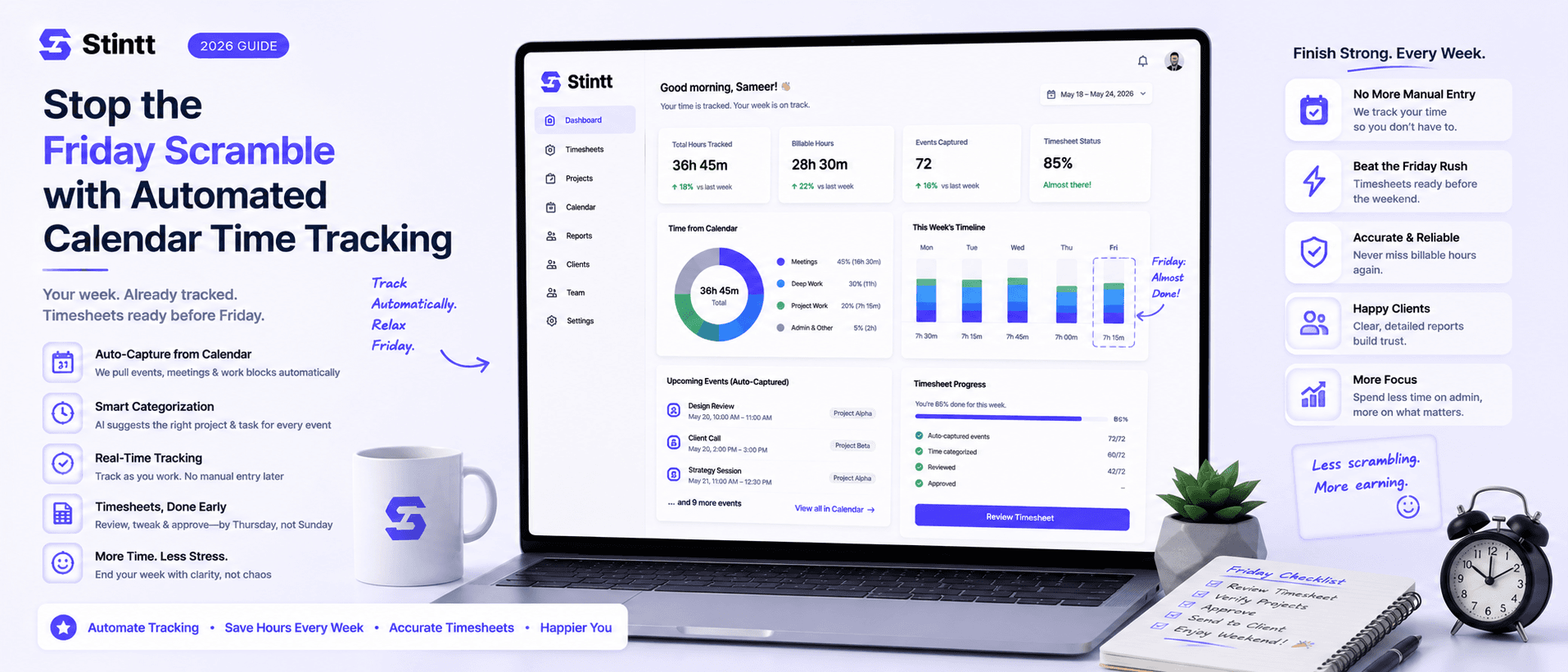
Stop the Friday Scramble with Automated Calendar Time Tracking
Automated calendar time tracking takes the events already sitting in your team's Google Calendars and turns them into drafted timesheet entries each person reviews and approves. Nobody reconstructs a week from memory at 4pm on Friday, and you stop spending Monday chasing the people who never submitted. Here's what the Friday scramble really costs, how calendar-based tracking closes the loop through to invoices, and where it's the wrong fit.
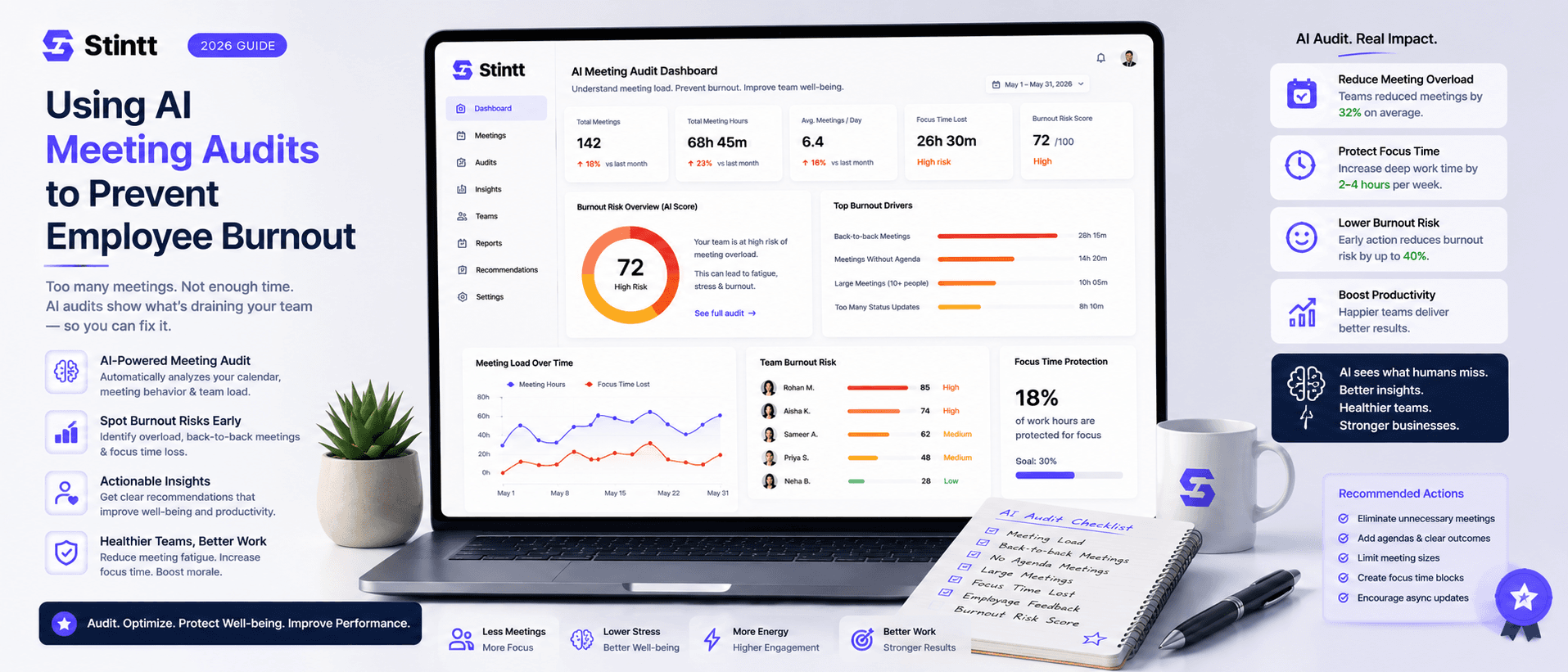
Using AI Meeting Audits to Prevent Employee Burnout
The average professional spends nearly 13 hours a week in meetings — about 84 working days a year — and constant context-switching quietly drains 20% of their mental capacity. At some point a packed calendar stops being busy and starts being a burnout risk. An AI meeting audit reads the calendar your team already keeps and gives you an honest split of meeting load versus focus time, early enough to rebalance workloads before people quit. Here's how it works, the frameworks that make meetings earn their place, and how to gather the insight without tipping into surveillance.