

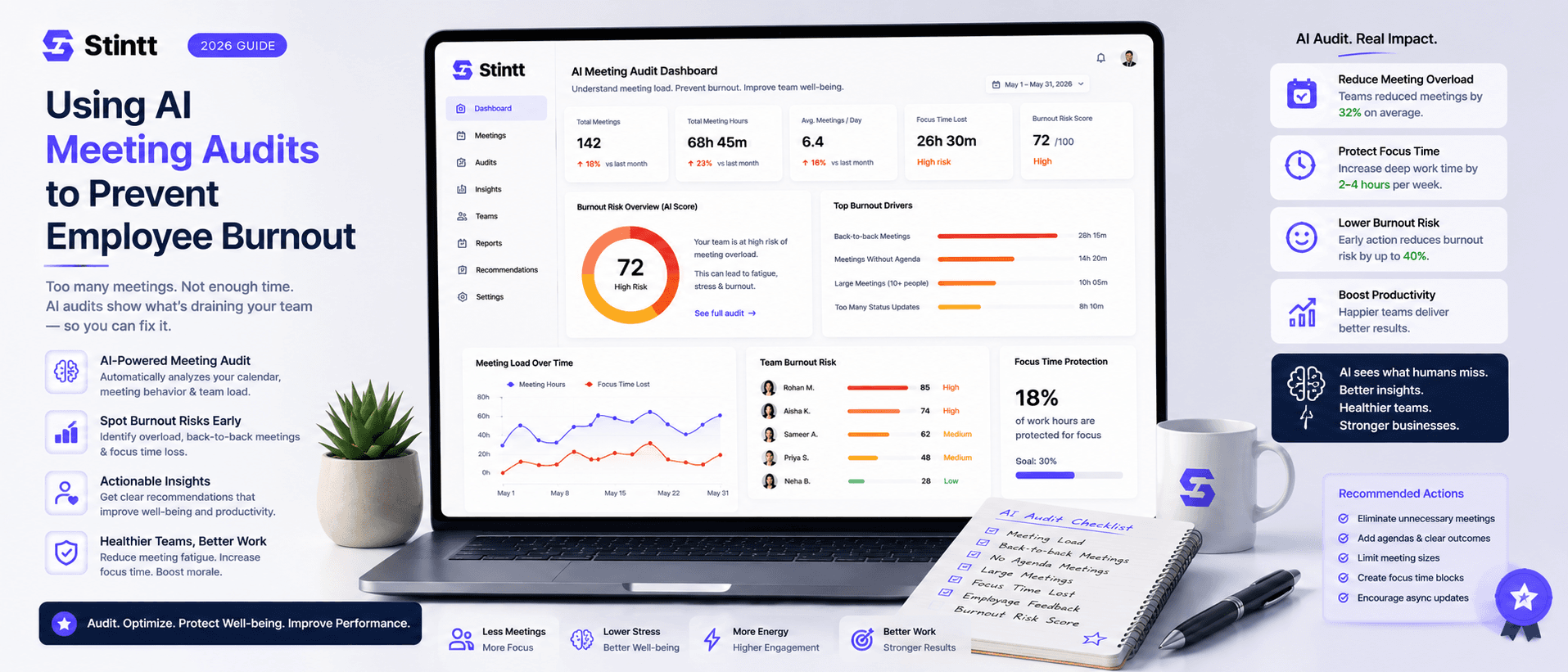
Using AI Meeting Audits to Prevent Employee Burnout
The average professional spends nearly 13 hours a week in meetings — about 84 working days a year — and constant context-switching quietly drains 20% of their mental capacity. At some point a packed calendar stops being busy and starts being a burnout risk. An AI meeting audit reads the calendar your team already keeps and gives you an honest split of meeting load versus focus time, early enough to rebalance workloads before people quit. Here's how it works, the frameworks that make meetings earn their place, and how to gather the insight without tipping into surveillance.
Using AI Meeting Audits to Prevent Employee Burnout
The average professional now spends 12.9 hours a week in meetings — roughly 84 working days a year. Add the 20% drop in mental capacity that comes from constantly switching between back-to-back calls, and it stops being a scheduling annoyance and becomes a health problem. Burnout is now widespread, and a lot of it traces back to a calendar nobody has actually looked at.
That's the gap an AI meeting audit closes. Instead of guessing whether a team is overloaded, you read the calendar they already keep and get an honest split of meeting load versus focus time — early enough to do something about it.
What meeting overload actually costs

The obvious cost is the hours in the calls. The expensive one hides behind them. A 2024 Gallup study put lost productivity from declining engagement at $438 billion globally — and disengagement and overload feed each other.
For the individual it's more concrete. Poor mental health costs nearly 12 missed workdays a year on average, and people in frequent burnout are 63% more likely to call in sick and three times more likely to job-hunt. Half of employees in severe burnout are already planning to leave. Replacing them isn't cheap: burnout-related turnover can run 15–20% of total payroll. The point where it gets dangerous is when meetings swallow the day whole and there's simply no room left for the work someone was actually hired to do.
How an AI meeting audit surfaces hidden overload
Overload hides behind a comforting assumption: a full calendar looks like productivity. An audit breaks that illusion by classifying where the time really goes.
Stintt does this by reading calendar events and sorting each one into meetings, focus work, admin, or breaks. That single split — meeting load against actual focus time — is usually enough to spot the person who hasn't had a two-hour uninterrupted block in three weeks, or the standing meeting that quietly ate everyone's mornings. You stop reconstructing the week from memory and start reading it from data.
The move for a manager is simple: look at the split per person, find the unsustainable cadence, and rebalance before it turns into a resignation rather than after.
Cutting manual timesheets cuts fatigue too

There's a quieter contributor to burnout worth naming: the admin about the work. The Friday scramble to reconstruct a week of hours from memory is real cognitive strain, piled on top of an already full schedule, and it produces worse data the more tired the person is.
Pulling entries straight from the calendar removes that chore. Connect through a read-only scope, let the tool categorize events into meetings, focus time, and admin, and the mental replay at week's end simply stops. People get the bandwidth back, and the record is more accurate because it was captured as things happened, not remembered afterward.
Frameworks that make meetings earn their place
Auditing tells you where the load is. Frameworks give you something to do about it. Two are worth standardizing on:
- The 25/50 rule. Cap meetings at 25 or 50 minutes instead of the default hour. The leftover buffer becomes recovery time and a real gap for focus, instead of another back-to-back handoff.
- 40/20/40 design. Put 40% of the effort into preparation, 20% into the meeting, and 40% into structured follow-up. It turns a status-sharing void into something with an actual outcome.
- Require an agenda 24 hours ahead, and keep invite lists to people who genuinely need to be there.
- Move routine status updates to async, so nobody sits through information they could have read.
- Name a Directly Responsible Individual per project — the RACI framework helps — so decisions don't need a meeting to happen.
- Audit standing meetings on a schedule and kill the ones that no longer earn their slot.
Insight without surveillance
There's a line an audit must not cross, and it decides whether people trust the tool or quietly game it. The goal is aggregated patterns — team-level meeting load, capacity trends — not watching individuals.
This is where the mechanism matters. Stintt takes no screenshots, logs no keystrokes, and does no screen or app monitoring. It reads the calendar your team already shares, on a view-only scope, and surfaces where the time goes. Bring people into the decision to adopt it: a tool framed as reducing their admin gets used honestly; one that feels like a monitor gets fed careful fiction. The data is only as good as the trust behind it.
Start with one honest audit
Burnout prevention isn't a dashboard — it's the supportive conversation the dashboard prompts. But you can't have that conversation without seeing the load clearly first.
Start there. Using Stintt's 18-month calendar history, run one meeting audit, find the recurring waste, and reclaim the focus time it's been eating. Moving off manual tracking and onto an honest picture of the week is the first real step toward a workload your team can actually sustain.
- See how Stintt builds automatic timesheets from Google Calendar
- Set up the Google Calendar timesheet integration
- Try the free timesheet calculator
- Compare plans on Stintt pricing
Related articles

Free Timesheet Templates for Freelancers 2026
Download free timesheet templates designed for freelancers in 2026. Excel, Google Sheets, and auto-generated options — plus a smarter alternative that fills itself.
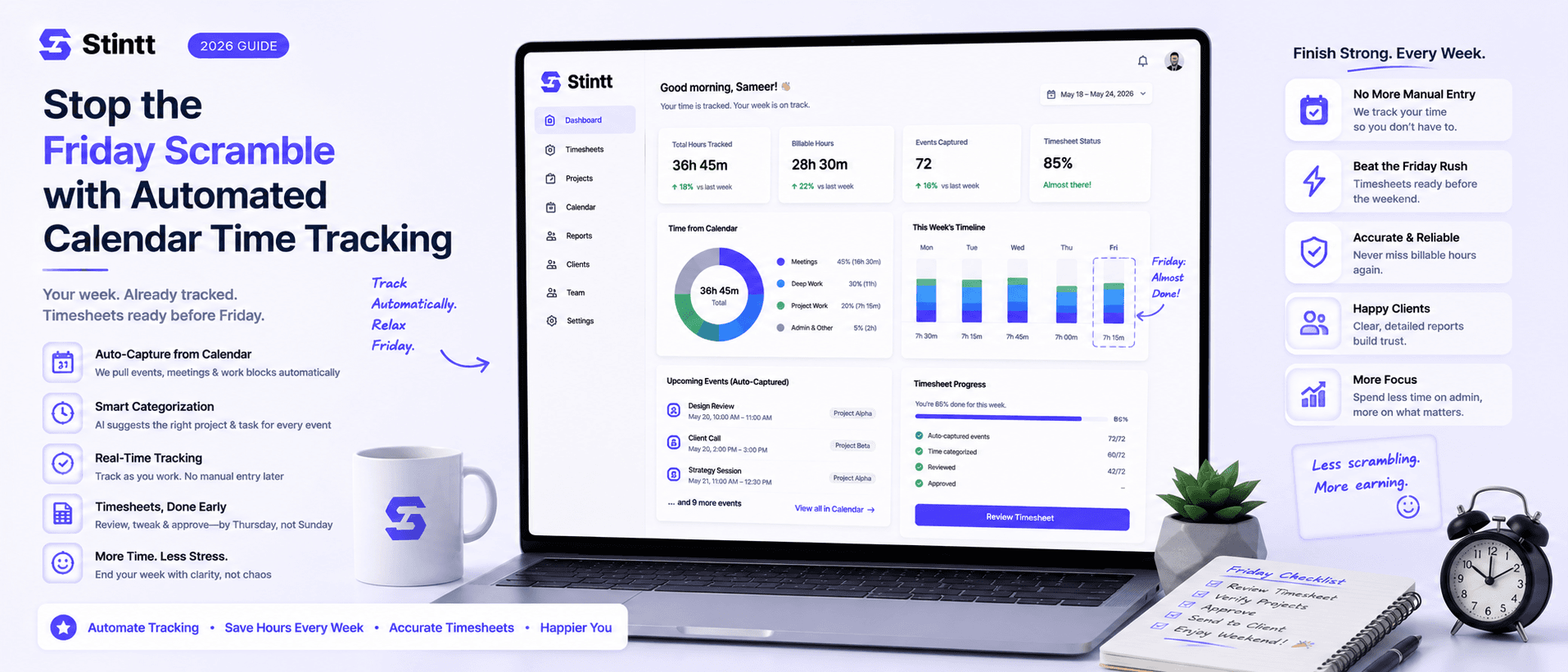
Stop the Friday Scramble with Automated Calendar Time Tracking
Automated calendar time tracking takes the events already sitting in your team's Google Calendars and turns them into drafted timesheet entries each person reviews and approves. Nobody reconstructs a week from memory at 4pm on Friday, and you stop spending Monday chasing the people who never submitted. Here's what the Friday scramble really costs, how calendar-based tracking closes the loop through to invoices, and where it's the wrong fit.
How to Track Work Hours Accurately (Without Forgetting)
Inaccurate time tracking leaks hours you actually worked. Here are practical strategies and tools to capture every one of them without constant manual logging.