


Your Calendar Already Knows Your Day — Stop Telling It Twice
Double entry between calendar and timesheet is the most common knowledge-work waste. There is one source of truth — let us use it.
Your Calendar Already Knows Your Day — Stop Telling It Twice
There is a quiet absurdity in modern knowledge work. You schedule a call. You attend the call. You make notes during the call. Then, on Friday, you re-type the call into a separate grid — date, duration, project, description — as if it never happened.
That second entry is the part nobody designs around. We accept it as the cost of having a timesheet.
What double entry actually costs
- 20–40 minutes per week, every week, per person
- Errors creep in (wrong dates, missed meetings, off-by-an-hour mistakes)
- The original record (your calendar) and the official record (your timesheet) drift apart
- Audits and disputes become harder because the two systems disagree
The premise we built around
Your calendar is the source of truth. Everything else should derive from it.
When you accept a meeting, the start, end, attendees, and title are captured. When you block time for deep work, the duration is recorded. When a 30-minute call runs to 47 minutes, your calendar still knows.
Stintt reads that record (read-only — we never write to your calendar) and produces the timesheet from it. One source. One truth. Zero re-typing.
What this changes
- Your week is already done by Friday. You review it, you do not rebuild it.
- Disputes get easier. Calendar-backed entries hold up because they are auditable.
- Your hands are free for higher-value work — design, code, customer conversations, anything but data re-entry.
What other tools force on you
Most time-tracking apps want you to add a second layer of input on top of the calendar — start a timer, hit a button, fill in a description. They assume the calendar is incomplete. We think it is the most complete record you already have.
A practical first step
If this resonates, the easiest test is to do nothing different for one week and just connect your calendar. On Friday, open Stintt and see how much of your week is already captured. For most people, the answer is "almost all of it."
Try one Friday with us → — free, read-only, no credit card.
- See how Stintt builds automatic timesheets from Google Calendar
- Set up the Google Calendar timesheet integration
- Try the free timesheet calculator
- Compare plans on Stintt pricing
Related articles

Free Timesheet Templates for Freelancers 2026
Download free timesheet templates designed for freelancers in 2026. Excel, Google Sheets, and auto-generated options — plus a smarter alternative that fills itself.
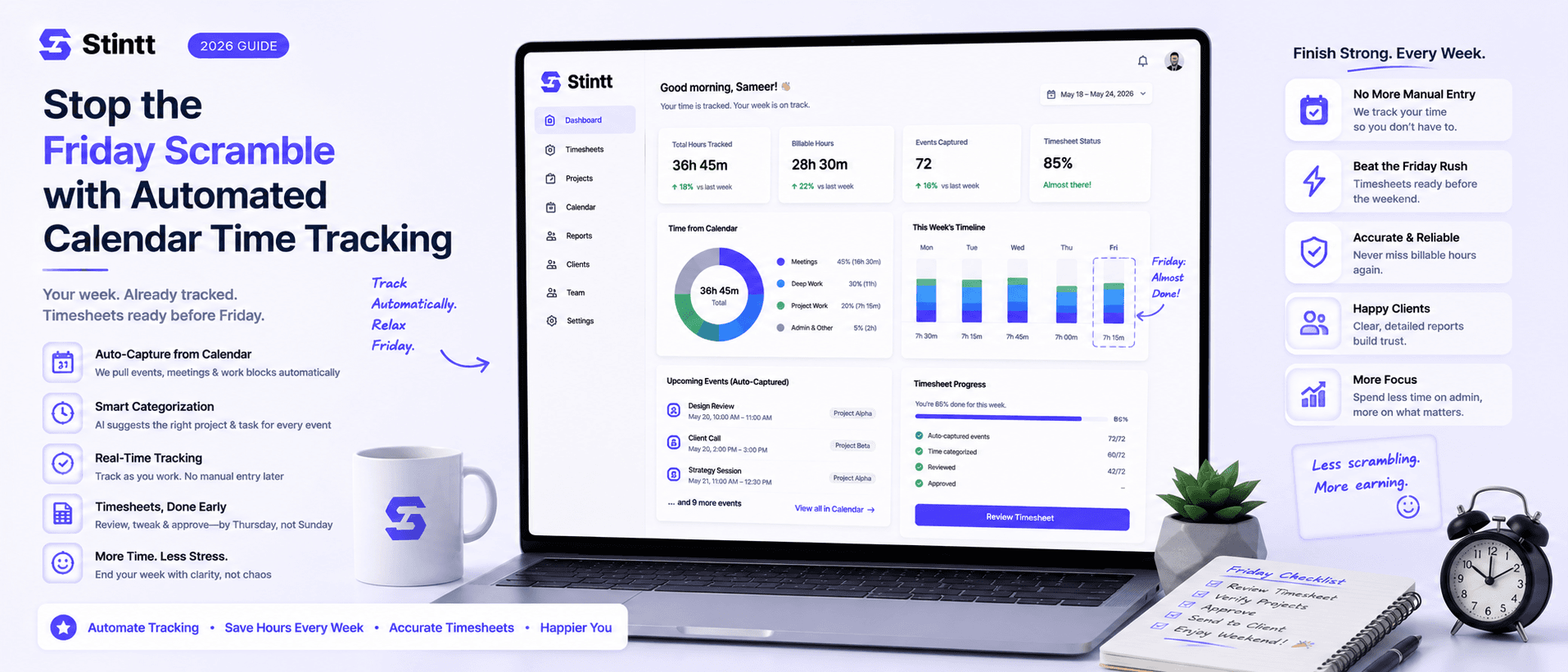
Stop the Friday Scramble with Automated Calendar Time Tracking
Automated calendar time tracking takes the events already sitting in your team's Google Calendars and turns them into drafted timesheet entries each person reviews and approves. Nobody reconstructs a week from memory at 4pm on Friday, and you stop spending Monday chasing the people who never submitted. Here's what the Friday scramble really costs, how calendar-based tracking closes the loop through to invoices, and where it's the wrong fit.
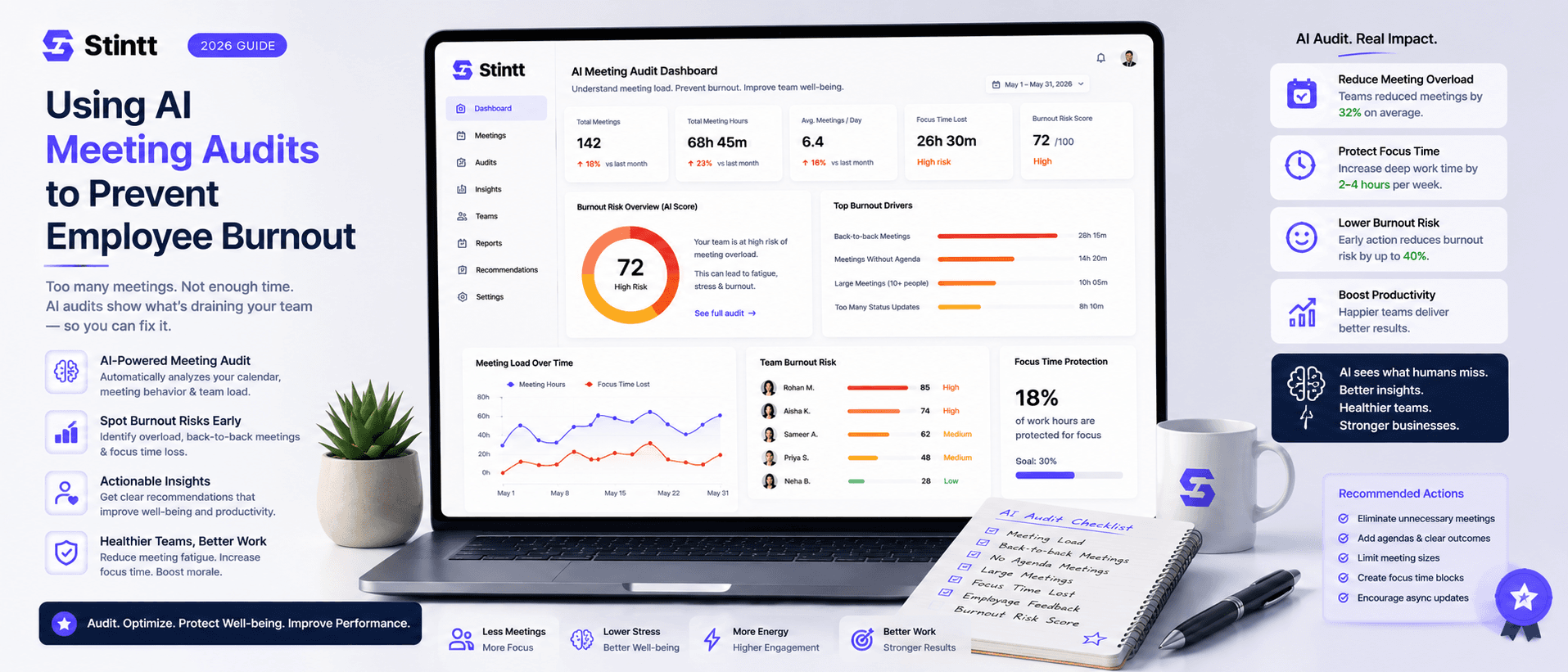
Using AI Meeting Audits to Prevent Employee Burnout
The average professional spends nearly 13 hours a week in meetings — about 84 working days a year — and constant context-switching quietly drains 20% of their mental capacity. At some point a packed calendar stops being busy and starts being a burnout risk. An AI meeting audit reads the calendar your team already keeps and gives you an honest split of meeting load versus focus time, early enough to rebalance workloads before people quit. Here's how it works, the frameworks that make meetings earn their place, and how to gather the insight without tipping into surveillance.