

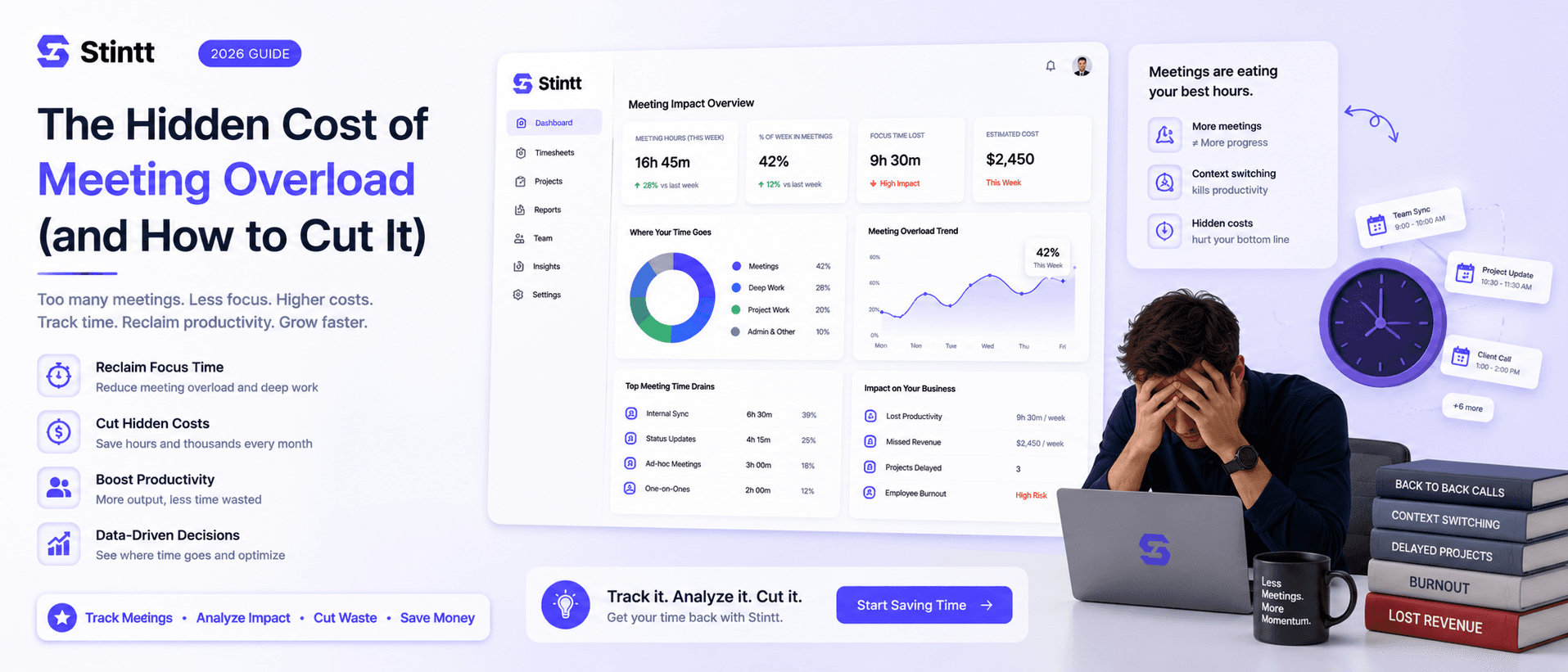
The Hidden Cost of Meeting Overload (and How to Cut It)
Meetings quietly drain US teams of an estimated 24 billion hours a year — about $399 billion in wasted cost — and most of it hides in plain sight on the calendar. This piece breaks down the real cost of interruption, the metrics that actually signal team health, and how to surface the waste, protect deep work, and build a meeting culture that respects people's capacity.
The Hidden Cost of Meeting Overload (and How to Cut It)
Meetings are the tax nobody puts on the balance sheet. In the US alone, teams lose an estimated $399 billion a year to wasted meeting time. For most teams that's not a line item they can see. It's just a week that somehow filled up.
The problem with manual time tracking is it never catches the scale of this. A spreadsheet tells you hours were spent; it doesn't tell you half of them went to a recurring sync nobody needed. Stintt reads your calendar and categorizes what's already there — surfacing the recurring meeting waste that stays invisible in a spreadsheet — so scheduling becomes a decision instead of a default.
The real cost of constant interruption
The dollar figure is only half of it. The other half is what fragmentation does to a workday. Back-to-back sessions leave no room to reset, which drives cognitive fatigue and, over time, burnout. Drexel University research found the average employee now spends up to a third of their week in meetings — and rates nearly half of them a waste of time.
The math scales unkindly with seniority: the cost of a meeting climbs fast as you add senior attendees. When sessions feel irrelevant, engagement drops, participation thins out, and you get a cycle of follow-up messages trying to recover what the meeting should have settled.
The teams that suffer most are the ones flying blind. You can't fix what you can't see — which is the whole case for putting a real number on routine practices instead of assuming they're fine.
The metrics that actually signal team health

Stop measuring hours logged and start measuring outcomes — completion rates, deliverable quality, and a handful of signals that show whether the team is actually healthy:
- Resource utilization — capacity against real project demand.
- Planned vs. actual time — estimated duration next to what tasks really took, so your next forecast is sharper.
- Meeting load — the volume and density of synchronous sessions, before they cause fatigue.
- Collaboration balance — the ratio of deep-work blocks to collaborative overhead.
Seeing capacity clearly

Manual capacity planning is a spreadsheet that's out of date the moment you save it. It gives you a fragmented view of who's actually available, which makes protecting deep work nearly impossible. Tools that read your calendars directly consolidate those scattered views into one picture of how time is being spent — no manual upkeep.
The mechanism is simple: events get sorted into focus time, admin, and meetings, and the patterns give you objective visibility into where time really goes. That matters because heavy meeting loads are a documented driver of meeting fatigue and, per the WHO, burnout as an occupational phenomenon.
Once the categorization is in place, the recurring waste and over-allocation are easy to spot:
- Consolidates calendars, eliminating manual entry and tagging errors.
- Highlights heavy meeting loads hiding in recurring activity patterns.
- Gives a clear, current view of the mix between collaboration and focus time.
Practical ways to cut meeting waste
You don't need a culture overhaul to start — a few defaults do most of the work:
- Shorten the defaults. 25- or 50-minute blocks instead of 30 and 60 build in the buffer people need to reset between calls. University of Washington researchers tie the lack of that buffer directly to virtual-meeting fatigue.
- "No agenda, no attenda." Every invite states its objective and what each person is expected to contribute, or it doesn't go out.
- Expire recurring meetings. Put an end date on every recurring series so stale syncs drop off the calendar instead of consuming capacity forever.
- Surface the waste with data. Let analytics separate unproductive syncs from focused project work, so you're cutting based on evidence, not vibes.
Where the money actually leaks
The $399 billion headline captures the direct salary cost of the hours in the call — but that's only the visible part.
The hidden tax is recovery. It takes real time to get back into deep focus after an interruption, and that's before you count the time spent preparing for the meeting itself. Ignore those layers and you get chronic fatigue, burnout, and the turnover that follows — each its own operational cost. Shifting from activity-based scheduling to outcome-focused work, guided by what the calendar data actually shows, is how you claw that value back and protect the focus time quality work depends on.
Tools that automate meeting hygiene

A productive calendar needs systems, not willpower. Stintt syncs directly with Google Workspace and categorizes events into meetings, focus work, and admin on its own — no manual tagging, no spreadsheet. The categorized view gives you the evidence to shorten or kill sessions that have stopped earning their place.
The manager's real challenge is seeing team load without tipping into surveillance. Stintt threads that by surfacing recurring meeting waste and load patterns — reading the rhythm of the calendar, not watching anyone's screen. That's how you move from reactive scheduling to a model that respects capacity and steadily trims the cost of overload.
Building a meeting culture that lasts
Defaults get you started; governance makes it stick.
- Expire recurring meetings by default, forcing each series to re-justify its place rather than accumulating as calendar debt.
- Go document-first. Recorded video updates and shared docs carry information that never needed a live sync, which protects the Maker vs. Manager schedule and the deep focus makers need.
- Put meeting-load data into performance objectives. Measure the collaborative overhead, not individual tasks, so the whole team is aligned on the same goal.
Reclaim your team's time
Moving from reactive scheduling to intentional capacity management is the clearest way to protect a team from burnout. Insight into the calendar is what finally makes the recurring patterns and fragmentation visible — turning a chaotic calendar into a balanced one where focus time is treated as a core resource, not whatever's left over.
And this does more than tidy calendars. It improves work-life balance and frees the deep-focus periods that unnecessary syncs quietly eat. Cut the invisible tax of low-value meetings, and the reclaimed energy goes where it should: into the work that actually moves your business. If your team runs on Google Calendar, connect your calendar free and see where your week is really going.
- See how Stintt builds automatic timesheets from Google Calendar
- Set up the Google Calendar timesheet integration
- Try the free timesheet calculator
- Compare plans on Stintt pricing
Related articles
ClickUp Time Tracking to Excel: Step-by-Step Guide
ClickUp has solid built-in time tracking, but exporting it to Excel for clients or management is clunky. Here are three ways to get your ClickUp hours into a proper spreadsheet.
How to Create Timesheets from Asana Tasks
Asana doesn't have native timesheet export. Here's how to turn your Asana tasks and time tracking into professional timesheets for clients and managers.
How to Export Microsoft Teams Meetings to a Timesheet
Your Teams calendar already tracks every meeting. Here's how to turn that data into a professional timesheet — manually, with Power Automate, or with an automated tool.